
What Is Dry Ice Cleaning?
Dry ice cleaning (also called dry ice blasting) is a non-abrasive, non-conductive cleaning process that uses compressed air to propel solid CO₂ pellets at high velocity to remove contaminants from surfaces. It is commonly used in industrial, automotive, manufacturing, and restoration applications where traditional cleaning methods are too aggressive, too wet, or too slow.
Unlike sandblasting or media blasting, dry ice cleaning does not damage the underlying surface when used correctly. Unlike pressure washing or chemical cleaning, it introduces no moisture and no chemical residue.
How It Works
Dry ice cleaning relies on three combined physical effects:
1. Kinetic Energy
The dry ice pellets strike the surface and break the bond between the contaminant and the substrate.

2. Thermal Shock
Dry ice is extremely cold (-109.3°F). When it contacts a warmer surface, the rapid temperature change causes contaminants like grease, mold, or buildup to shrink and crack, loosening their grip.

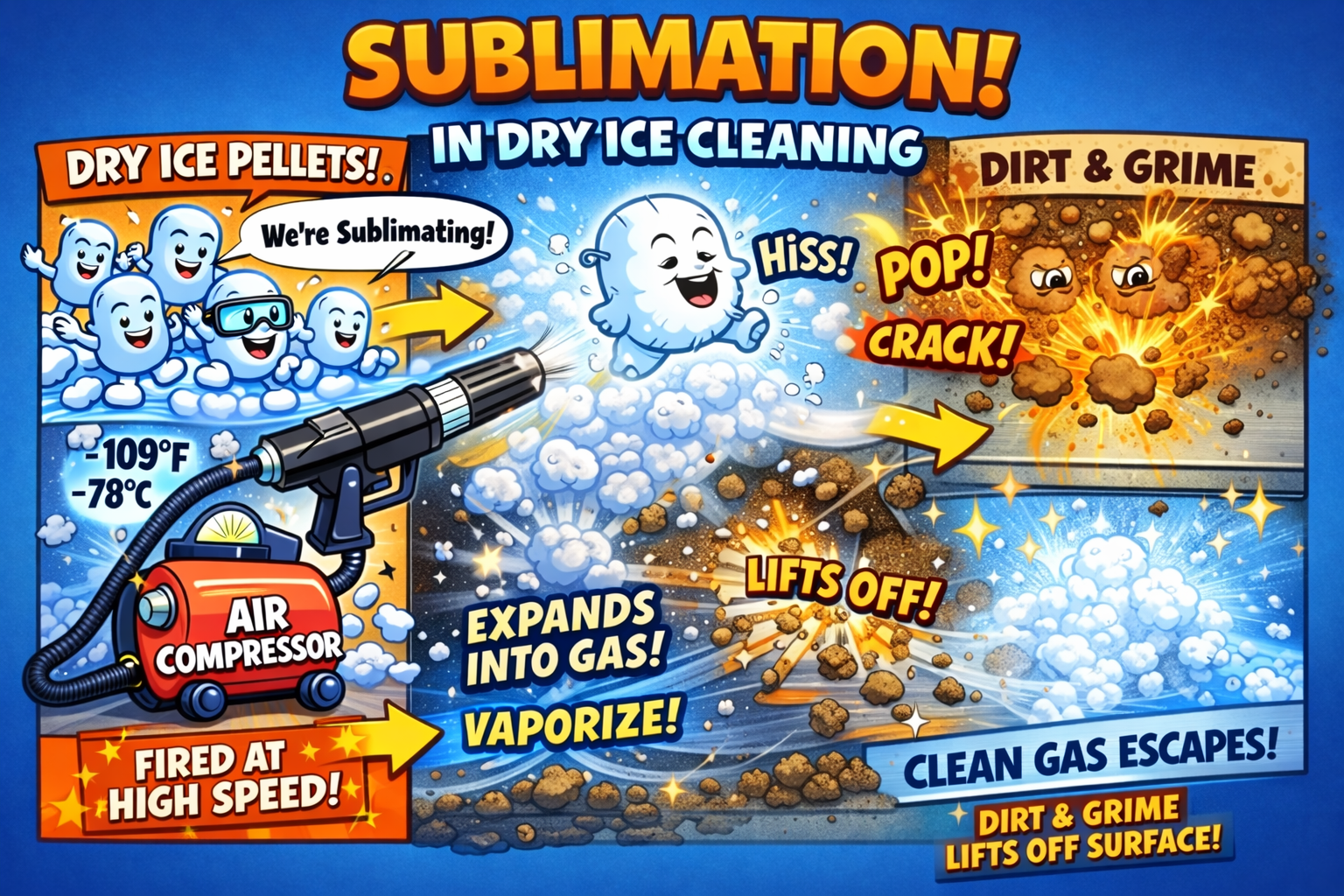
3. Sublimation
Sublimation is the process where a solid turns directly into a gas without becoming a liquid first.
When dry ice hits the surface, it instantly sublimates—expanding up to 800 times in volume. This rapid expansion creates a gentle lifting force that pushes contaminants away from the surface.
Because the dry ice converts directly into gas, there is no blasting media left behind. The only cleanup required is the removed contaminant itself.
Environmental Advantages
Dry ice cleaning is widely considered an environmentally responsible cleaning method.
No Secondary Waste
There is no sand, water, or media residue. Only the removed contamination needs to be collected and disposed of.
No Chemicals
The process uses reclaimed CO₂ and compressed air—no solvents, detergents, or hazardous chemicals.
No Water Usage
Dry ice cleaning is completely dry, eliminating wastewater, corrosion risk, and electrical hazards.
Equipment-Friendly
Because it is non-abrasive, dry ice cleaning extends the life of machinery, tools, and sensitive components.
Reduced Downtime
Equipment can often be cleaned in place and returned to service immediately—no drying or reassembly delays.
Recycled CO₂ source
The carbon dioxide used to produce dry ice is captured as a byproduct of industrial processes and repurposed, rather than newly created.
Where Does the CO₂ Come From?
The CO₂ used to make dry ice is not newly created for cleaning. It is captured as a byproduct from existing industrial processes, including:
Ethanol production
Ammonia manufacturing
Natural gas processing
Other fermentation and industrial operations
Instead of being released into the atmosphere, this CO₂ is captured, purified, and compressed into dry ice pellets. During cleaning, the CO₂ is simply returned to the atmosphere, making dry ice cleaning part of the existing carbon cycle, not a source of new emissions.

Why Choose Dry Ice Cleaning?
Non-abrasive and surface-safe
No moisture or chemical residue
Environmentally responsible
Minimal cleanup
Faster turnaround and reduced downtime
Dry ice cleaning is a modern, efficient solution for companies that demand high-performance cleaning while protecting equipment, employees, and the environment.